

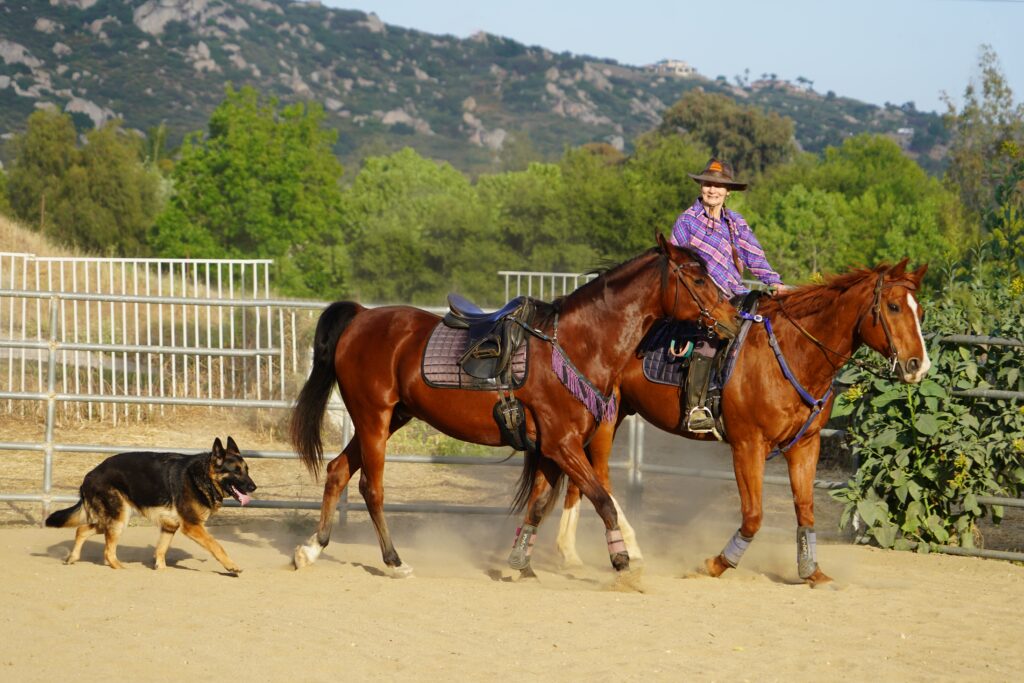
I began riding at the age of 3. My father started me on my journey with horses by taking me nearly every weekend to the Tilden Park Pony Rides (in the hills above Berkeley, CA). In my early teen years I spent my summers at a Napa County resort, Aetna Springs in Pope Valley, where my favorite daily activities including horseback riding.
In my twenties I began a career spanning 18 years working with thoroughbred racehorses on major US racetracks and at the then world’s largest privately owned thoroughbred breeding ranch, Rancho Jonata in Buellton, California. I worked my way up on the track, starting as a hot walker, then working as a groom, exercise rider and assistant trainer. On the breeding farm I spent 3 years starting colts under saddle. After retiring from race riding, I continue to own and ride horses.
As an Marriage Family Therapist intern, I became fascinated with the idea of “horse therapy” and trained at a local therapeutic riding organization. I learned about the Professional Association of Therapeutic Horsemanship, International, or PATH International, which has the highest reputation in the industry of therapeutic riding for its standards of safety. PATH also requires its members to uphold high standards of professionalism.
I embrace PATH’s standards of physical/emotional care of the equine during all Equine Facilitated Psychotherapy (EFP) sessions. I am a PATH Certified Equine Specialist in Mental Health and Learning as well as a PATH Certified Therapeutic Riding Instructor.
I spent hours working with one of my horses, a thoroughbred named Trabia, to make him into a well-trained therapy horse. Trabia, named by the Italian breeder after Sicilian city, has as his grandsire the great racehorse Secretariat. Trabia seems to enjoy his work.
I first experienced the therapeutic benefits of Equine Facilitated Psychotherapy (EFP) in 1985 when I decided to put my then 3 year old son on a quiet racing colt I had started under saddle. My son, now 42, has cerebral palsy and first walked without crutches at the age of 7. I thought that by having him ride the horse while I led them around a 500 acre ranch, he would benefit from the movement of the horse. “Horse” therapy benefited him greatly in that while riding Blue developed better muscle tone.
Unknown to me until I studied child development in grad school, my son also benefited as he moved through space on the horse. I learned that the brain requires stimulation such as moving through space in order to develop. My son’s brain developed rather well, and so did his self-esteem, in part due to riding. He acquired a sense of accomplishment about himself with his riding skills, and he learned that there is always a way to move forward. He now holds a two Bachelor’s Degrees and Master’s Degree in Classic Literature and works fulltime in Southern California.